Carlos Carrillo
About
BIO | CV | ARTIST STATEMENT | Publications (forthcoming)
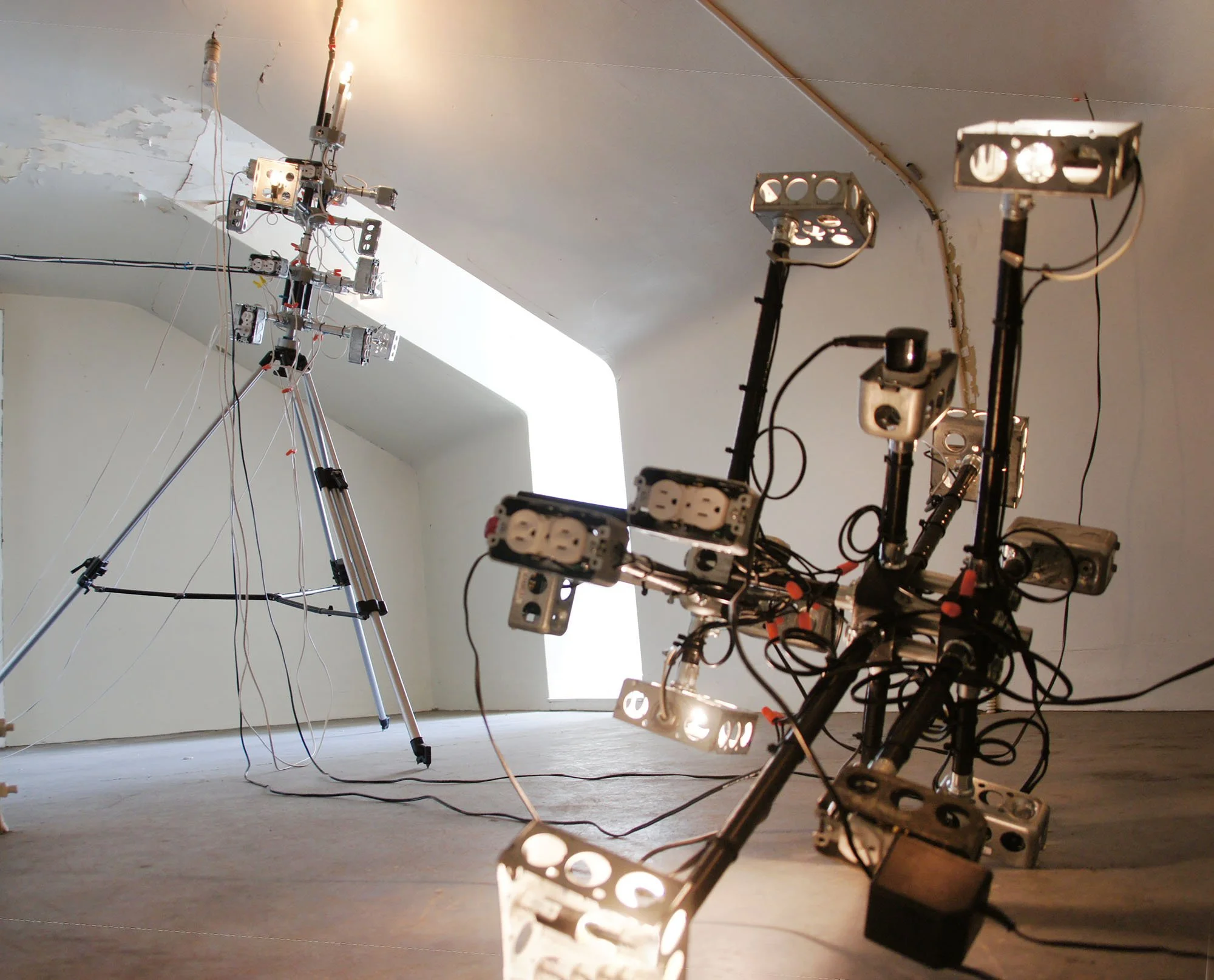
Carlos Carrillo’s installation practice operates both independently and within the collaborative framework of CCYD Studio.

Photo by Y. Davidoff, 2011. Location, CCYD Studio, Brooklyn, New York.
Carlos Carrillo (b. 1972) is a Mexican American multidisciplinary artist living and working in Austin, Texas. His practice spans painting, sculpture, and installation, using light, line, and industrial materials to examine how systems carry meaning through light, structure, and time.
Carrillo received his BFA with Honors from the School of Visual Arts in New York in 2002. While at SVA, he studied with artists including Jack Whitten, Tim Rollins, Frank Gillette, Suzanne Anker, and Andrew Ginzel—relationships that helped shape a practice grounded in process, material clarity, and long-term investigation.
While studying at SVA, Carrillo began developing works using everyday technological and industrial materials. Shortly after graduating, he co-curated his first group exhibition, Low-tech Organics, which examined accessible materials, reuse, and spatial behavior. This inquiry later evolved into what he describes as tech nor ganic—an approach that continues to inform his studio practice.
His work has been exhibited from New York to Los Angeles, including presentations at White Box, Vito Acconci Studio, the Brooklyn Museum Community Project, and Tiger Strikes Asteroid. In 2024, Carrillo was selected to exhibit in the 2025 Texas Biennial in Houston, and he is currently preparing a collaborative suspended installation with Yevgenia Davidoff for a 2026 exhibition at the UMLAUF Sculpture Garden + Museum.
Alongside his studio practice, Carrillo is a Certified Technology Specialist (CTS) and works professionally as an audiovisual systems engineer. This parallel discipline directly informs his approach to structure, signal flow, and spatial experience. He has also completed projection mapping studies at Dada Lab and is an alumnus of the ICOSA Collective.
Across scales and formats, Carrillo’s work is designed to be experienced in real space. His objects and environments function as quiet systems—holding light, structure, and restraint—inviting sustained attention rather than spectacle. His practice continues to evolve through careful making, repetition, and a commitment to presence in an increasingly mediated world.
WORK
Installations




Sculptures